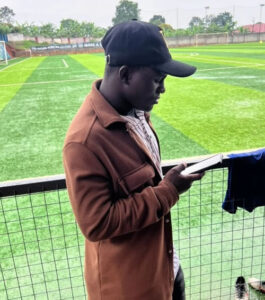
Most readers will never fully grasp the weight of those words. If you grew up far from poverty, it’s almost impossible to imagine. And if you did grow up with comfort, you might even dismiss the sentence as an exaggeration.
But it isn’t. It is meant literally. Mike’s story is a story of survival. A story of willpower, resilience, and the ability to hold on to optimism even when life is at its darkest. It is also a story that, hopefully, gives perspective. Sometimes our own problems shrink when we compare them to the wider world. Mike Mubiru was born just outside Masaka, a city in southwestern Uganda with around 100,000 inhabitants. His life is shaped by hardship and survival — but also by character, kindness, and football’s ability to change a life.
Player Story
“My mother died when I was only three years old. From that moment, life became very difficult because I grew up without a mother’s love and care,” he says. Her death marked the beginning of a childhood defined by poverty and instability.
His father couldn’t take care of him, and Mike grew up on the streets. He had no safe home. Every day was about survival — literally — even though he was only three years old. There were periods where Mike lived entirely on the streets, going whole days without food. He slept wherever he could: abandoned houses, street corners, and old broken-down cars in a taxi park.
“Many nights I slept wherever I could find a safe place. It was a very hard life, but it taught me resilience, humility, and never to give up. Life was so difficult, and I didn’t even know where my father’s home village was. I had no place to call home, and I had to find my own way through life.”
He survived by collecting scrap metal, plastic bottles, and anything he could sell for a few coins. He carried baskets of tomatoes and onions for market vendors, earning just enough to buy food for the day.
It was a childhood without comfort, without safety, and without anyone to protect him. A young boy of three or four years old.
And as if that wasn’t enough, death was a constant companion.
“I have siblings, but we didn’t really grow up together. Everyone fought their own battles, and life took us in different directions. I was born into a family of eight children, but I never met my two oldest brothers or my oldest sister because they died before I was born. Of the five siblings I knew, three have also passed away. Today, only two of us are still alive.”
Football as a refuge
In the middle of all the darkness, Mike found one thing that gave him hope — something that made him forget his problems: football.
He and his friends didn’t have a real leather ball, so they made one from plastic bottles. They played on the streets; organised football wasn’t for boys like Mike. But the local academy coach, Ibrahim, noticed him.
“He found me while I was playing with a ball made from plastic bottles. He saw something in me that many people never saw.”
Mike was only six or seven at the time, and he remembers having lived on the streets for two or three years already. Ibrahim gave him the chance to join a local academy — a place with food and schooling — and it became the turning point of his life. For the first time, he was allowed to be a child. For the first time, someone took care of him.
For Mike, Ibrahim became more than a coach. He became proof of something Mike often talks about today:
that one adult who chooses to see a child can change the entire direction of that child’s life.
Mike says he wouldn’t be alive today if Ibrahim hadn’t given him that chance. It wasn’t a grand gesture. It was simply a man choosing to believe in a little boy with a ball made from plastic bottles.
But for Mike, it was everything. It was hope. It was light. It was the beginning of a new life.
During his years as a homeless child, Mike lost contact with his father. But at the academy, under Ibrahim’s care, Mike’s brother recognised him — and the two were reunited.
My own meeting with Mike
I met Mike for the first time when I became a coach at the academy where he played. He was a quiet boy with a look that said more than words ever could. I knew nothing about his background. I didn’t know he had lost his mother at three. I didn’t know he had lived on the streets. I didn’t know he had slept in abandoned houses and old cars, or that he had collected scrap metal to survive.
I just saw a boy who loved football — and who happened to be very good at it.
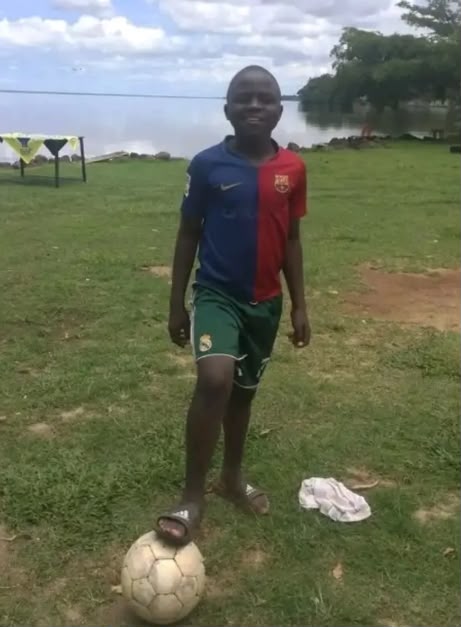
Even without knowing his story, there was something special about him. He wasn’t the boy I was closest to, but he was one of the boys everyone looked up to. He had a natural authority, a calmness, and a maturity rarely seen in children. He set the standard. He was the one who stepped forward when something needed to be done properly. And with his quiet strength, he lifted the others.
His talent was obvious. He wasn’t just good — he was exceptionally good. The kind of talent that makes you think that if the right people had seen him, his life could have taken a completely different path. His playing style reminded me of a young Wayne Rooney: energetic, relentless, technically strong, physically powerful, and with an enormous work rate.
But despite all that, it was his character that struck me.
Mike always had a grateful smile. He was always humble, polite, and respectful. He carried a gentle kindness — the kind you only see in people who have known deep pain. His eyes shone with gratitude, but also with a vulnerability that revealed a life far harder than any child should endure. I didn’t know his story then, but I could feel it.
Later, when I learned his story, I understood why his eyes held that mix of strength and fragility. I understood why he carried himself with a maturity that didn’t come from football, but from life.
And I understood something else — something Mike himself hopes readers will see: His story is not only a story of suffering. It is a story of hope.
When I see Mike work with children today, I understand that football’s purpose isn’t only to create professional players. For Mike, football fulfilled its purpose in another way. It took him off the streets, it gave him food, school, safety, and people who believed in him. It gave him a future and today it gives him the chance to pass all of that on to other children.
My first meeting with Mike was not just meeting a talented boy.
It was meeting a child who had survived more than anyone should — and who had still chosen to meet the world with kindness.
The missed opportunity — and football as salvation
Mike’s talent was so great that he was selected for Uganda’s U15 national team for a tournament in China against Brazil, Japan, Russia, and South Korea. He delivered performances that normally change a life — including being named Man of the Match against South Korea.

He remembers being told about interest from European academies, but the middleman wanted something in return to pursue the opportunity — and Mike simply had nothing to give.
A little demoralised that his performances in China didn’t lead to anything concrete, and with his motivation slightly shaken, he still tried to chase the dream. But a few days before signing with a club in Uganda’s top division, he suffered a foot injury. The club withdrew.
Mike didn’t see it as a curse. He saw it as a calling.
He wanted to help children the way Ibrahim had helped him — through football. Today, Mike is both Scouting Coordinator at Nyota Scouting and a central part of Maryland Soccer Academy in Masaka. Here he gives back. He coaches and mentors boys who often come from the same difficult circumstances as he did — children who have lost a parent or who grow up without safety. Sadly, this is common in Uganda, a country where life expectancy remains far below the global average.
Mike often says that even though he didn’t become a professional footballer, football still saved and defined his life. It didn’t give him fame or wealth but it gave him a mission and a purpose.
He is now the adult role model he himself lacked as a child.
Sadly, Mike also recently lost his father after illness. He is only 20 years old — and now an orphan. It is a pain that could break most people. But for Mike, it has strengthened his mission to be the adult he never had.
To give children the love, support, and opportunity he never received.
Mike’s gratitude
Despite everything Mike has lost, and everything he has had to fight through, one thing repeats itself in everything he says: gratitude.
He expresses it so simply that it’s hard to understand how the words can come from someone who has endured so much pain:
“I’m just grateful that God never forgot me.”
For Mike, it’s not just a sentence. It’s a philosophy. And he hopes readers understand that his story is not only about suffering — it is also about hope, and about people who chose to help even when they could only give a little. A bag of food. A kind word. A chance.
But for Mike, these were never small things. They were proof that the world had not forgotten him. He also says:
“Hardship has made me the person I am today.”
Not many 20-year-olds can say that after losing both parents, sleeping in cars and on the streets, and losing almost all their siblings. But Mike carries his past as part of his strength — not as a burden.
His gratitude is not naive. It comes from knowing what it feels like to have nothing — and therefore appreciating everything.
Football changes lives
Mike is proof that football is not just a game. Football can change lives — and it doesn’t have to be through an international career. Football took Mike off the streets. It gave him school, food, and a refuge. It gave him hope. It gave him a way out.
And today, football gives him work and purpose through Maryland Soccer Academy and Nyota Scouting, where he helps the next generation of Ugandan talents get the chance he never received.
Mike’s story is harsh and heartbreaking — but it is also beautiful. It shows what happens when a child meets an adult who believes in him. And it shows that the world’s greatest game — football — can save lives.
Mike shares his story because he hopes it reminds people that you don’t need to change the whole world to change a life. Sometimes changing one child’s world is enough.
Ibrahim did that for him.
And today, Mike does it for others.
It is the chain of hope he wants readers to see — and perhaps even become part of themself one day.